
The best wholesale products for convenience stores and retailers include beverages, packaged snacks, candy, gum and mints, personal-care products, household essentials, and replacement accessories that match local customer demand. Automotive products, apparel, novelties, and operational supplies also fit stores with the customers, space, and purchasing capacity to support them.
According to the National Association of Convenience Stores’ 2025 industry results, U.S. convenience stores generated $341.2 billion in foodservice and merchandise sales in 2025, an increase of 1.7% over 2024. These figures cover in-store sales, excluding fuel. They provide industry context rather than a sales forecast for an individual store.
The 12 categories below cover merchandise for resale and supplies for store operations. Retailers can choose products by comparing customer demand, gross profit, sales speed, order quantities, shelf life, and storage needs.
Resale merchandise serves customers, while internal-use supplies support the business. Both belong in purchasing plans, but they require different inventory measures.
How Are Wholesale Product Quantities Packaged?
Wholesale product quantities are packaged as individual units, packs, or cases. Each packaging level specifies how many items a retailer purchases and how those items are grouped.
- Sellable unit: The package sold to a customer, such as one bottled drink or one battery pack.
- Wholesale pack: A purchasing package containing a specified number of individual units.
- Case: An outer package containing multiple individual units or smaller packs.
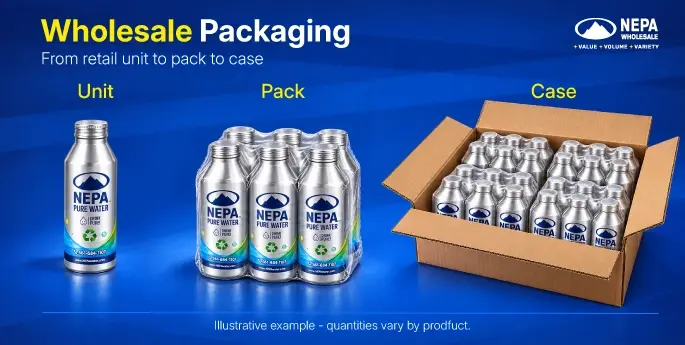
Pack and case quantities vary by product. For example, a beverage case may contain 24 individually sellable bottles, while another product’s case may contain 12 packs. Retailers check the packaging details to confirm the total number of sellable units and calculate the cost per unit.
The right purchasing quantity matches expected demand, remaining shelf life, storage space, and available cash. These factors help retailers choose suitable quantities within each product category.
Which Wholesale Product Categories Should Convenience Stores and Retailers Consider?
Convenience stores and retailers consider 12 wholesale categories: beverages, snacks and bakeries, candies and bars, gums, mints and antacids, health and beauty care, household items, lighters and fuels, electronics, automotive products, apparel, novelties, and office and store supplies.
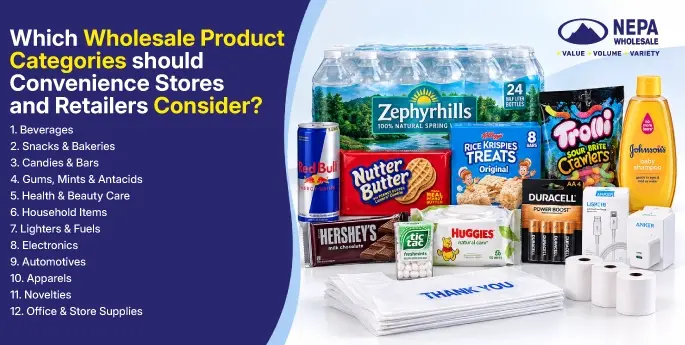
Each category serves a different purchasing occasion or operational purpose. The order below organizes the assortment; it does not represent a verified nationwide sales ranking.
Product Category | Customer need or operational purpose | Product examples | Principal stocking constraint |
1. Beverages | Immediate consumption and take-home drinks | NEPA Pure Water, Zephyrhills water, Red Bull | Cooler capacity, package size, and backstock |
2. Snacks & Bakeries | Quick snacks and packaged food | Nutter Butter cookies, Rice Krispies Treats, Hostess Donettes | Remaining shelf life and retail format |
3. Candies & Bars | Individual treats and sharing occasions | Hershey’s bars, Trolli gummies, Tootsie Pops | Heat exposure and display space |
4. Gums, Mints & Antacids | Gum and mint purchases; separate OTC needs | Extra gum, Tic Tac mints, Tums | Pack quantities, labeling, and applicable expiry |
5. Health & Beauty Care | Personal-care replacement and family needs | Huggies wipes, Johnson’s baby shampoo | Customer suitability and package condition |
6. Household Items | Replacement essentials for home use | Duracell AA and AAA batteries | Product specifications and shelf space |
7. Lighters & Fuels | Lighter replacement and compatible refills | BIC lighters, Clipper lighters, Special Blue butane | Compatibility, storage, and handling |
8. Electronics | Charging and accessory replacement | Y-MAX cables, wall adapters, car adapters | Device compatibility and variant selection |
9. Automotives | Driver-related purchases and vehicle care | Air fresheners, tire gauges, windshield washer fluid | Customer relevance and storage volume |
10. Apparels | Clothing and accessory purchases | Bandanas, gloves, thermal shirts | Size, color, climate, and season |
11. Novelties | Gifts, accessories, and occasional purchases | Sunglasses, dice displays, sketch pens | Audience suitability and sell-through |
12. Office & Store Supplies | Checkout, packaging, and pricing | Thermal paper, shopping bags, pricing labels | Equipment compatibility and consumption |
Frequently consumed products require different purchasing quantities from occasional replacement items. Impulse purchases depend on customer interest and presentation, seasonal merchandise depends on timing, and operational supplies follow business consumption.
The following sections explain each category’s role, examples, and selection constraints. Exact products, variants, purchasing quantities, and availability require confirmation before ordering.
1. Beverages
Beverages suit convenience stores and retailers serving demand for immediate-consumption and take-home drinks. Beverages include bottled water, energy drinks, sodas, and other packaged beverages in different sizes and purchasing formats.
The category has measurable importance in convenience retail. NACS’s 2025 category results show that packaged beverages accounted for 18.7% of in-store sales, up 0.8 percentage points from 2024.
NACS also reports that energy drinks contributed more than 28% of packaged-beverage sales in 2025. The second figure applies to the beverage category, not total in-store sales.
Customer preferences determine which brands, flavors, and formats belong in the assortment. Single bottles, cans, and multipacks serve different shopping occasions and require different display arrangements.
Bottle volume, case quantity, refrigeration requirements, and shelf life guide the selection of wholesale beverages. Cooler display capacity determines what customers see, while backstock capacity determines how much inventory the store can hold.
Beverage selection also provides a basis for evaluating snacks purchased during the same shopping trip.
2. Snacks & Bakeries
Snacks and bakery products suit convenience stores and retailers serving quick eating occasions and packaged-food purchases. Snacks & Bakeries includes cookies, cereal treats, packaged bakery items, pretzels, and meat snacks.
Examples include Nutter Butter cookies, Rice Krispies Treats, and Hostess Donettes. Each product type requires its own assessment of package size, storage, and remaining shelf life.
NACS’s 2025 industry findings report 7.9% sales growth for alternative snacks, including jerky, seeds, and nuts. This represents sales-value growth for that category, not growth for every snack or bakery product.
Single-serving formats suit individual purchases, while larger packages serve different customer needs. Familiar products supported by sales records provide a starting assortment; unfamiliar products benefit from limited trials.
Retail-unit labeling, outer-pack quantities, and date checks guide the selection of wholesale snacks and bakery products.
Snacks and beverages often serve the same shopping occasion. Their placement can reflect that relationship, with actual sales used to evaluate the result.
3. Candies & Bars
Candies and bars suit convenience stores and retailers serving individual-treat, sharing, and occasional impulse purchases. Candies and bars include chocolate bars, gummies, chewy candy, and hard candy, such as Hershey’s bars, Trolli gummies, and Tootsie Pops.
This category focuses on confectionery rather than the cookies, bakery items, and meat snacks covered above.
NACS’s review of 2025 merchandise performance reports that 435 new candy and salty-snack items entered the convenience channel in 2025. The figure covers both categories together and does not establish demand for every new product.
Regular bars, sharing packages, and candy bags differ in retail-unit size and display footprint. Wholesale packs also differ in the number of individually sellable units they contain.
Retail format, purchasing quantity, and heat sensitivity guide comparisons of wholesale candies and bars. Chocolate products require suitable storage, while all dated products require checks on remaining selling time.
4. Gums, Mints & Antacids
Gums, mints, and antacids provide three distinct product options for convenience stores and retailers: chewing gum, breath mints, and over-the-counter antacid merchandise. Gums, Mints & Antacids include examples such as Extra gum, Tic Tac mints, and Tums.
Gum packages differ by stick count, container type, and wholesale-pack quantity. Mint packages differ in dimensions and display requirements. Those attributes affect purchasing quantities and counter space.
Customer-facing package size and sellable units per wholesale pack guide the selection of wholesale gums, mints, and antacids.
Antacids require separate evaluation because they are medicinal merchandise. The exact label, package integrity, expiration date, and storage instructions determine the relevant stocking checks.
A shared category does not make confectionery and OTC purchasing requirements identical.
5. Health & Beauty Care
Health and beauty care products suit convenience stores and retailers serving personal-care replacement, travel, and family shopping needs. Health & Beauty Care includes examples such as Huggies wipes and Johnson’s baby shampoo.
The suitable package depends on the customer and purchase occasion. A compact shampoo bottle serves a different need from a larger family-use package, while wipes require their own assessment of pack size and shelf space.
Customer requests and recorded purchases help determine which health and beauty care products deserve regular replenishment.
Package seals, closures, storage instructions, and dates, where applicable, require checking. Damaged packaging affects suitability even when the product type matches customer demand.
Personal-care products and medicinal merchandise require separate labeling, storage, and expiry checks.
6. Household Items
Household items suit convenience stores and retailers whose customers buy replacement essentials during short shopping trips. Household Items include products such as Duracell AA and AAA batteries.
Specifications matter within this category. AA and AAA batteries fit different devices, so demand for one size does not establish demand for the other.
Customer-facing pack size, product dimensions, purchasing quantity, and storage requirements guide the selection of wholesale household items.
Compact essentials require less display space than bulky household merchandise. Larger products need sufficient demand to justify both shelf and backstock capacity.
Household products sold to customers remain separate from cleaning, maintenance, or other supplies consumed by the business.
7. Lighters & Fuels
Lighters and fuels suit convenience stores and retailers with demand for replacement lighters and compatible refill products. Lighters & Fuels includes disposable lighters, refillable models, torch-style products, and lighter fuels.
Examples include BIC lighters, Clipper lighters, and Special Blue butane. The exact model determines whether a lighter is disposable or refillable.
Manufacturer instructions establish suitable combinations of wholesale lighters and fuels. Brand familiarity alone does not establish fuel compatibility.
Purchasing quantities and display dimensions determine how much stock fits the store. Fuel containers also require attention to product instructions, supplier handling conditions, storage, and heat exposure.
These checks keep the assortment focused on suitable lighter and fuel formats.
8. Electronics
Electronics accessories suit convenience stores and retailers serving immediate charging, connection, and replacement needs. Electronics include cables, wall adapters, car adapters, and other accessories.
Compatibility determines whether an accessory meets the customer’s needs. Relevant attributes include connector type, cable length, power capability, supported functions, and adapter specifications.
The USB Implementers Forum distinguishes cable capabilities within its compliance program. Its requirements include 60W or 240W power-capability markings for USB-C-to-USB-C cables before compliance testing. These requirements do not establish certification for a particular NEPA product.
Exact specifications and device compatibility guide the selection of wholesale electronics accessories.
Overlapping variants increase inventory complexity when customers cannot distinguish them. Clear connector labels, readable specifications, and suitable display security support product selection.
9. Automotives
Automotive products suit convenience stores and retailers serving drivers who need vehicle-related accessories, replacement items, or care products. Automotives includes examples such as air fresheners, tire gauges, and windshield washer fluid.
The store’s customer base determines the category’s relevance. A gas station on a travel route has different purchasing occasions from a retailer serving mainly pedestrian traffic.
Product dimensions, package quantities, and storage needs guide the selection of wholesale automotive products. A gallon container requires more capacity than a carded air freshener or tire gauge.
Vehicle fluids and repair products require exact label and compatibility checks. Customer requests and sales records determine which products deserve continued space.
10. Apparels
Apparel suits convenience stores and retailers with local demand for clothing and accessories that fit the season, customer profile, and available display space. Apparel includes examples such as bandanas, gloves, and thermal shirts.
Size and color create separate inventory variants. Sales of one variant do not establish demand for the full range.
Local climate and the remaining selling season affect purchasing quantities. Thermal clothing requires a different seasonal assessment from a year-round accessory.
Controlled trials of wholesale apparel, where purchasing terms allow them, provide evidence before assortment expansion.
Apparel selection works best when the store has a clear purchase occasion and sufficient demand to manage unsold variants.
11. Novelties
Novelties suit convenience stores and retailers whose customers make gift, accessory, seasonal, or occasional purchases. Novelties include products as sunglasses, dice displays, and sketch pens.
These products require selection by audience and purchase occasion. A sunglasses display serves a different need from a pen assortment or dice display.
Display footprint, customer suitability, buying quantity, and seasonality guide the selection of wholesale novelties.
Sell-through provides evidence for expansion. Sell-through is the proportion of units available during a defined period that were sold. Opening stock and receipts require consistent treatment when comparing product trials.
Novelty products need measured demand rather than assumptions that every unusual item will sell.
12. Office & Store Supplies
Office and store supplies support convenience-store and retail operations such as checkout, packaging, pricing, and daily administration. Office & Store Supplies includes thermal paper rolls, shopping bags, pricing labelers, and pricing labels.
These products serve an operational purpose when the business consumes them. Their purchasing quantities depend on usage and replenishment rather than customer sales.
Printer specifications determine suitable thermal paper, including roll width, diameter limits, and paper type. Pricing labels need to match the labeler, while bags need to suit their intended use.
Consumption rates, equipment compatibility, and storage capacity determine suitable quantities of wholesale office and store supplies.
A receipt roll used at checkout is an operating supply. A packaged item offered to customers is resale inventory. Those uses require separate records.
How Can Retailers Identify the Best Wholesale Products for Their Store?
Retailers identify the best wholesale products by comparing customer demand, gross profit, sales velocity, space requirements, and inventory exposure over the same period. Category suitability provides the starting point; product-level performance determines the final assortment.
Sales velocity measures units sold per day or another defined period. Inventory exposure describes stock and cash at risk from slow sales, expiry, damage, or unsold variants.
Evaluation factor | What to measure | Purchasing implication |
Customer demand | Units sold, repeat requests, and stockout periods | Establishes whether customers seek the product |
Gross profit | Net sales revenue less cost of goods sold | Measures merchandise contribution |
Sales velocity | Units sold divided by days measured | Shows how quickly stock moves |
Space requirement | Shelf, cooler, display, and backstock needs | Tests whether the quantity fits |
Inventory exposure | Stock value, dates, unsold units, and variants | Identifies purchasing risk |
A consistent period, such as a 30-day review, makes comparisons more useful. Stockout periods also need recording because unavailable products cannot generate sales.
For a new store, customer research and controlled trials provide initial evidence until reliable sales records become available.
Neither the highest margin nor the lowest purchase price alone determines suitability. The product also needs demand, workable quantities, and sufficient space.
Which Wholesale Products Sell Best and Generate the Most Gross Profit?
The wholesale products with the highest unit sales sell best, while those with the highest total gross profit contribute the most merchandise profit over the same period. Store-level sales and cost records identify those products.
NACS’s 2025 merchandise benchmarks illustrate the difference between sales contribution and gross-profit contribution:
Category | Share of in-store sales | Share of in-store gross profit |
Packaged beverages | 18.7% | 22.2% |
Candy | 3.1% | 4.6% |
These figures are shares of in-store totals, not category gross-margin percentages.
Product comparisons require separate measures:
- Gross profit per unit: Net selling revenue per unit minus the corresponding cost of goods.
- Total gross profit: Net sales revenue during the period minus cost of goods sold.
- Gross margin: Gross profit divided by net sales revenue, expressed as a percentage.
In a hypothetical 30-day comparison, two products generate equal gross profit per unit, but one sells twice as many units. That product generates twice the total gross profit for the period.
A lower-margin product can also generate more total gross profit through higher sales volume. Revenue, gross profit, and net profit remain separate measures; net profit accounts for the business’s other relevant expenses and income.
Which Categories Fit Different Convenience Stores and Retailers?
Suitable categories depend on the store’s customers, shopping occasions, available cash, storage capacity, and replenishment arrangements. The same wholesale category requires different purchasing quantities and formats across store types.
Store scenario | Categories to evaluate | Main constraint |
Small convenience store | Proven beverages, snacks, candy, gum and mints, and selected essentials | Limited cash and space |
Gas station or travel-focused store | Beverages, snacks, personal care, electronics, and automotive products | Immediate-use formats and compatibility |
High-traffic convenience store | Categories with demonstrated local demand | Availability and replenishment capacity |
Other retail formats | Categories aligned with existing merchandise | Customer fit and variant exposure |
These scenarios narrow the selection without requiring every store to stock all 12 categories.
Which Categories Fit Small Convenience Stores?
Beverages, snacks, candy, gum and mints, and selected replacement essentials fit small convenience stores when demand, package quantities, shelf life, and display requirements suit their resources.
Customer requests and recorded sales provide the starting assortment. Outer-pack quantities need comparison with expected demand before cash and backstock space are committed.
Unfamiliar apparel, novelty, and accessory variants require limited trials before expansion. Purchasing capacity also needs to remain available for replenishing proven products.
Which Categories Fit Gas Stations and Travel-Focused Stores?
Beverages, snacks, gums and mints, personal care, electronics, and automotive products fit gas stations and travel-focused stores when they meet immediate consumption and replacement needs.
Bottled drinks and packaged snacks serve eating and drinking occasions. Wipes, compatible charging accessories, and driver-related essentials address different replacement needs.
Refrigeration capacity, connector specifications, package dimensions, and customer traffic determine suitability. Local requests and sales records establish which products deserve continued space.
Which Categories Fit High-Traffic and Other Retail Stores?
Categories with demonstrated local demand fit high-traffic stores, while categories aligned with the existing merchandise focus fit other retail formats.
Busy stores need sufficient display stock, staff capacity, and reliable replenishment for proven products. High customer traffic does not establish demand for every category or variant.
Other retailers select products by store purpose. A gift-focused retailer has a reason to evaluate novelties, while a personal-care retailer has a reason to assess relevant health and beauty products.
The selected category still requires product-level checks on demand, purchasing quantities, and storage.
What Should Retailers Consider Before Turning Their Product Selection Into a Wholesale Order?
Retailers consider purchasing quantity, total acquisition cost, storage, and replenishment before turning product selections into a wholesale order. A suitable product needs a workable purchasing arrangement.
1. Check quantity: Confirm sellable units, pack increments, and expected demand.
2. Compare cost: Include relevant acquisition charges.
3. Allocate storage: Identify suitable display and backstock capacity.
4. Plan replenishment: Account for sales rate, lead time, and availability.
The selected assortment determines how much inventory to buy, where to store it, and when to reorder.
How Should Retailers Compare the Total Cost of Wholesale Products?
Retailers compare the total cost of wholesale products using landed unit cost: the product cost plus relevant acquisition charges, divided by the number of sellable units acquired. Acquisition charges include applicable freight, delivery, and handling costs.
Landed unit cost = Total product and allocated acquisition costs / Sellable units acquired
Case price alone does not establish the full purchasing cost. In a hypothetical comparison, two suppliers offer identical 24-unit cases. One includes delivery, while the other adds a delivery charge. Allocating those charges establishes a comparable cost per sellable unit.
Retailers who calculate landed cost for wholesale purchasing compare different case quantities and fulfillment arrangements on the same basis.
Acquisition costs remain separate from operating expenses such as store rent, checkout labor, and utilities.
How Do Case Quantities and Minimum Order Requirements Affect Purchasing?
Case quantities determine purchasing increments, while minimum order requirements determine the smallest product quantity or order value accepted. These conditions affect the amount of stock and cash a purchase requires.
Purchasing checks cover:
- Confirm sellable units per pack.
- Confirm packs or units per case.
- Confirm product-specific minimum quantities.
- Confirm order-value requirements.
NEPA’s published purchasing guidance states that no minimum order is required. This does not establish that every product is available as one individual retail unit.
In a hypothetical example, a 24-unit pack lasts eight weeks when a store sells three units weekly. That coverage requires comparison with remaining shelf life, storage, and cash committed.
How Much Wholesale Inventory Should a Store Keep?
A store keeps enough wholesale inventory to cover expected demand until replenishment, with a buffer for variability that fits shelf life, storage, and available cash. The suitable quantity differs by product.
Display stock and backstock count toward the total. Display stock is available to customers; backstock replenishes the display.
Stock coverage in days = Usable units on hand / Average daily unit sales
In a hypothetical example, 60 usable units at six daily sales provide 10 days of coverage. This calculation describes the current position rather than establishing a universal target.
Consumables, accessory variants, seasonal merchandise, and operational supplies require separate coverage decisions because their demand and inventory risks differ.
When Should Retailers Reorder Wholesale Products?
Retailers reorder wholesale products when inventory position reaches expected demand during replenishment lead time plus safety stock. Lead time runs from placing the order to receiving usable stock.
Reorder point = Expected demand during lead time + Safety stock
In a hypothetical example, daily demand is six units, lead time is four days, and safety stock is 12 units:
Reorder point = (6 × 4) + 12 = 36 units
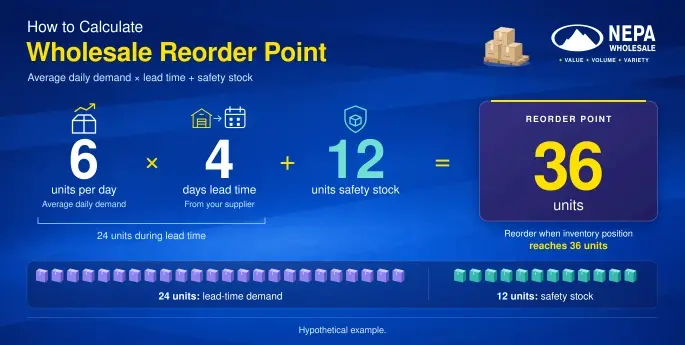
Inventory position includes usable stock on hand plus confirmed incoming stock, less stock already committed.
Sales records and actual delivery times help retailers set reorder points for wholesale products. Safety stock depends on demand and supply variability. The example’s 12-unit buffer illustrates the calculation rather than prescribing a quantity for every product.
How Can Retailers Reduce Slow Stock and Expiry Losses?
Retailers reduce slow stock and expiry losses through controlled trials, sales reviews, date checks, appropriate rotation, and seasonal purchasing. Each method addresses a different inventory risk.
Date wording matters. USDA guidance identifies “Best if Used By/Before” as an indicator of best flavor or quality rather than a purchase or safety date. The exact label and product storage instructions guide assessments of remaining selling time.
- Limit trial quantities for unfamiliar products and variants.
- Review sales to identify stock moving below expectations.
- Check dates and condition when receiving merchandise.
- Rotate dated stock so earlier-dated usable products receive priority.
- Plan seasonal quantities around the remaining selling period.
- Confirm supplier terms before assuming stock is returnable.
Food-quality dates and medicine expiration dates serve different purposes and require separate checks.
Unsold apparel sizes and novelties left after a seasonal occasion also require different corrective actions from dated consumables.
How Should Retailers Display Their Selected Products?
Retailers display their selected products according to visibility, shopping occasion, physical dimensions, security, and storage requirements. Customers need to recognize and compare products without obstructing checkout or compromising package condition.
Compact gum and mint packs fit checkout displays where space permits. Packaged snacks can sit along a beverage shopping route when storage requirements allow it.
Charging accessories require clear connector and specification labels. Higher-value or easily concealed items require suitable display security.
Available counter space and customer shopping needs help retailers plan checkout-counter products. Fixture measurements determine whether display packs fit without blocking payment equipment or product information.
Operational supplies need staff access and separation from merchandise offered for sale. Actual sales after placement changes provide evidence for further adjustments; placement alone does not establish that a product will sell.
Where Can Convenience Stores Buy Wholesale Products?
Convenience stores buy wholesale products through full-line distributors, specialty wholesalers, manufacturers, cash-and-carry businesses, and online B2B suppliers. Channel selection depends on the chosen assortment and fulfillment requirements.
Sourcing channel | Purchasing role | What to compare |
Full-line distributor | Supplies a broad store assortment | Category coverage, service area, and delivery arrangements |
Specialty wholesaler | Focuses on selected categories | Product depth and purchasing quantities |
Manufacturer-direct | Supplies a brand’s products | Account eligibility, volume requirements, and fulfillment |
Cash-and-carry | Supports purchasing and collection | Location stock, travel, and transport capacity |
Online B2B supplier | Supports digital comparison and ordering | Account access, availability, freight, and lead time |
Multi-category purchasing can consolidate ordering work. Its suitability still depends on total acquisition cost and reliability compared with separate category suppliers.
NEPA Wholesale offers merchandise and operational supplies across the categories covered here. The selected products and fulfillment arrangements need to fit the store’s purchasing plan.
How Can Retailers Evaluate a Nearby NEPA Wholesale Location?
Retailers evaluate a nearby NEPA Wholesale location by comparing travel practicality, business hours, collection arrangements, product availability, and applicable fulfillment options.
Addresses, hours, and contact details for NEPA Wholesale locations help buyers assess purchasing and collection arrangements.
Exact products and variants require confirmation at the relevant location before traveling. Pickup procedures and fulfillment options also depend on the order.
Transport and staff time belong in the comparison between collection and shipment. Proximity alone does not determine the lower acquisition cost.
What Should Retailers Confirm Before Ordering From NEPA Wholesale?
Retailers confirm account access, exact products, sellable-unit quantities, current quotes, availability, fulfillment, payment conditions, and return terms before ordering from NEPA Wholesale.
General business-account requirements and product-specific purchasing conditions need separate checks.
1. Confirm account access and applicable business documentation.
2. Verify products and variants, including size, flavor, color, or specification.
3. Confirm sellable units and the purchasing quantity.
4. Check current quotes and conditions attached to offers.
5. Confirm availability for the chosen fulfillment arrangement.
6. Verify pickup or shipping details, charges, and timing.
7. Confirm payment conditions for the order.
8. Review return procedures and product restrictions.
The NEPA Wholesale purchasing FAQs address general account and ordering questions. Conditions specific to products, offers, and fulfillment arrangements require confirmation with the NEPA team.
How Can Retailers Build Their Assortment With NEPA Wholesale?
Retailers build their assortment with NEPA Wholesale by shortlisting relevant categories, comparing suitable products and formats, confirming purchasing terms, and ordering around expected demand.
National category figures identify areas worth evaluating. Local customer needs, sales records, and inventory performance determine individual products and quantities.
Resale merchandise and operational supplies require separate purchasing records. Available funds also need to support replenishment of proven products.
The categories within NEPA Wholesale departments provide the starting point for matching the next order to customer demand, purchasing funds, and store capacity.

Best Wholesale Products for Convenience Stores and Retailers